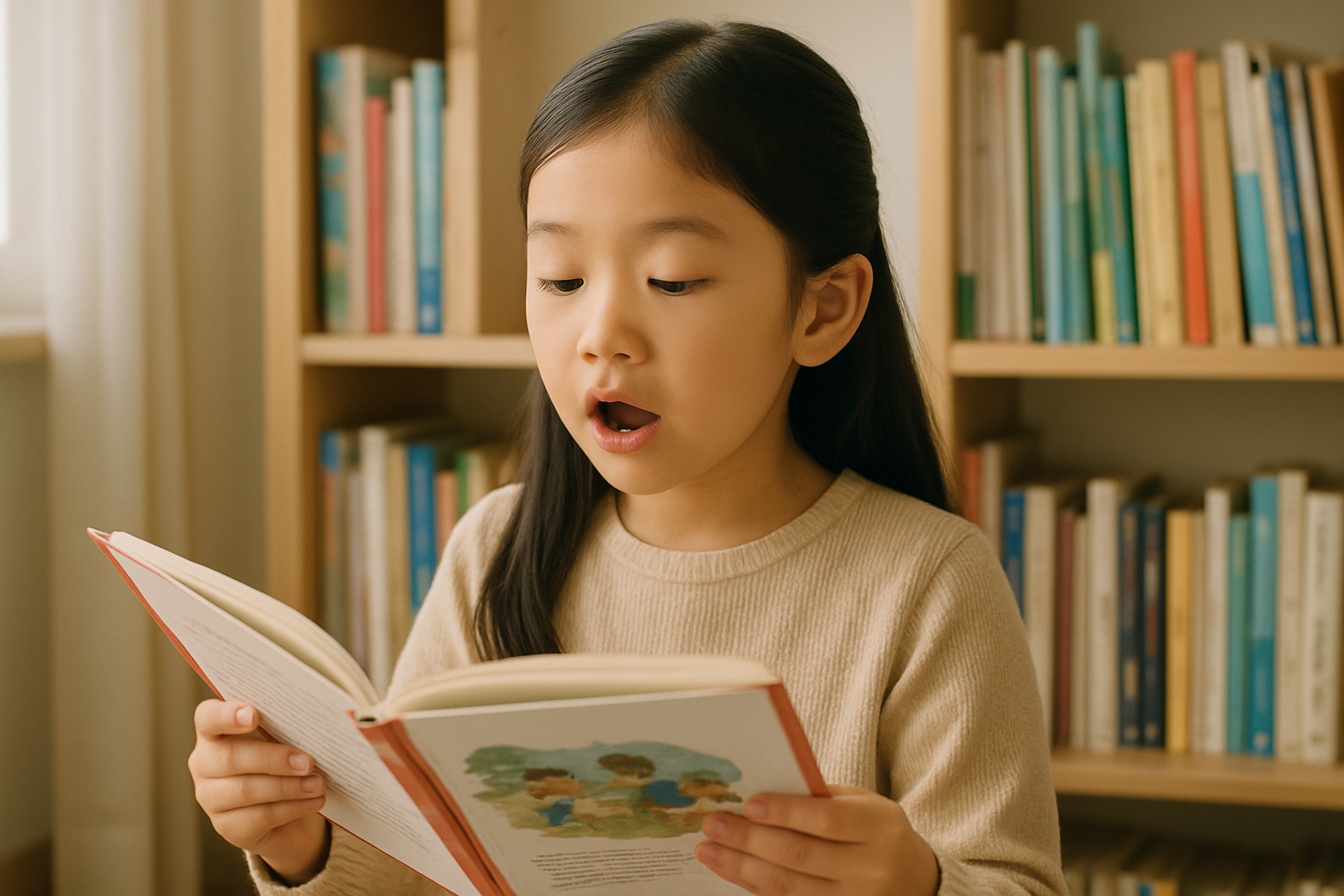
This imbalance often appears more strongly in children who have steadily followed Korean-style learning. Their reading level is above that of their peers, but their speaking is at a beginner level. Parents may easily interpret this as “having an introverted personality,” but in most cases, it is a matter of training, not personality. It is the result of using only the pathway for visual comprehension every day while hardly ever using the pathway for producing speech.
- Learning focused on silent reading develops only the comprehension pathway. Speaking requires separate practice for the muscles of the mouth and for retrieval.
- Three correction stages: reading aloud → speaking with sentence transformations → orally summarizing what was read.
- You can pause efforts to raise the reading level for a while. The imbalance is easiest to correct now that you have identified it.
The Pathways for the Eyes and Mouth Develop Separately
Reading is an input pathway that sees written words and understands their meaning. Speaking is an output pathway that selects words for the meaning in the mind and produces them through the muscles of the mouth. The two may appear to be the same English ability, but they use different muscles and develop separately unless trained separately. One hour of silent reading is zero minutes for the output pathway.
The good news is that children of this type already have abundant material. Because vocabulary and sentence patterns have accumulated in their minds, their speaking improves much faster than that of children starting from a blank slate once the output channel is opened.
One Hour of Silent Reading Is
Zero Minutes for the Speaking Pathway.
Three-Stage Correction Routine
Stage 1 · Reading Aloud (2–3 Weeks)
Have the child read aloud for 10 minutes every day from a book one or two levels below their current level. The reason for using an easier book is that the child can focus on pronunciation, intonation, and the muscles of the mouth without expending effort on decoding. Recording the reading and having the child listen to it increases the effect.
Stage 2 · Speaking with Sentence Transformations (2–3 Weeks)
This involves practicing changing the subject, tense, and object in sentences the child has read. Turn “He goes to school” into “She went to the park.” This practice of manipulating familiar sentence patterns in real time turns grammar knowledge into spoken grammar.
Stage 3 · Oral Summarization
Have the child describe the chapter they read in three sentences. The sentences do not have to be complete. From the moment the child reconstructs it in their own words, their reading assets begin to transfer into speaking assets. Once this stage becomes familiar, the child is ready to move on to a real-world setting such as an online video class. For choosing that setting, see Comparison of Online Video English and Tablet-Based English.
The Child Does Not Need a Grammar Workbook but More Practice Speaking
A common prescription for children whose grammar falls apart when they speak is to advance further in grammar, but that is the opposite direction. Their knowledge is already sufficient; what they lack is retrieval practice. Stage 2 training, in which they orally transform familiar sentence patterns, changes their spoken grammar faster than completing a workbook.
Pause the Reading Level for Just 4 Weeks
During that time, have the child read aloud for 10 minutes a day from a book two levels below their current level. If the child says it is childish, reframe it as a recording game or voice-acting game. If their intonation has become more natural after 4 weeks, they can move on to the sentence-transformation stage.
Frequently Asked Questions
If you see an imbalance, speaking comes first. Reading ability generally does not decline much if it is simply maintained, but the speaking pathway becomes more rigid the less it is used, and correction becomes more difficult as the child moves into higher grades.
Use a book one or two levels below the child’s level, but frame it as play, such as voice acting, recording, or a reading performance. The book needs to be easy so the child can focus on using their mouth rather than decoding.
This is not a lack of knowledge but a lack of automaticity. Instead of using a workbook, practicing transforming familiar sentence patterns aloud actually changes spoken grammar.